More Is Just More
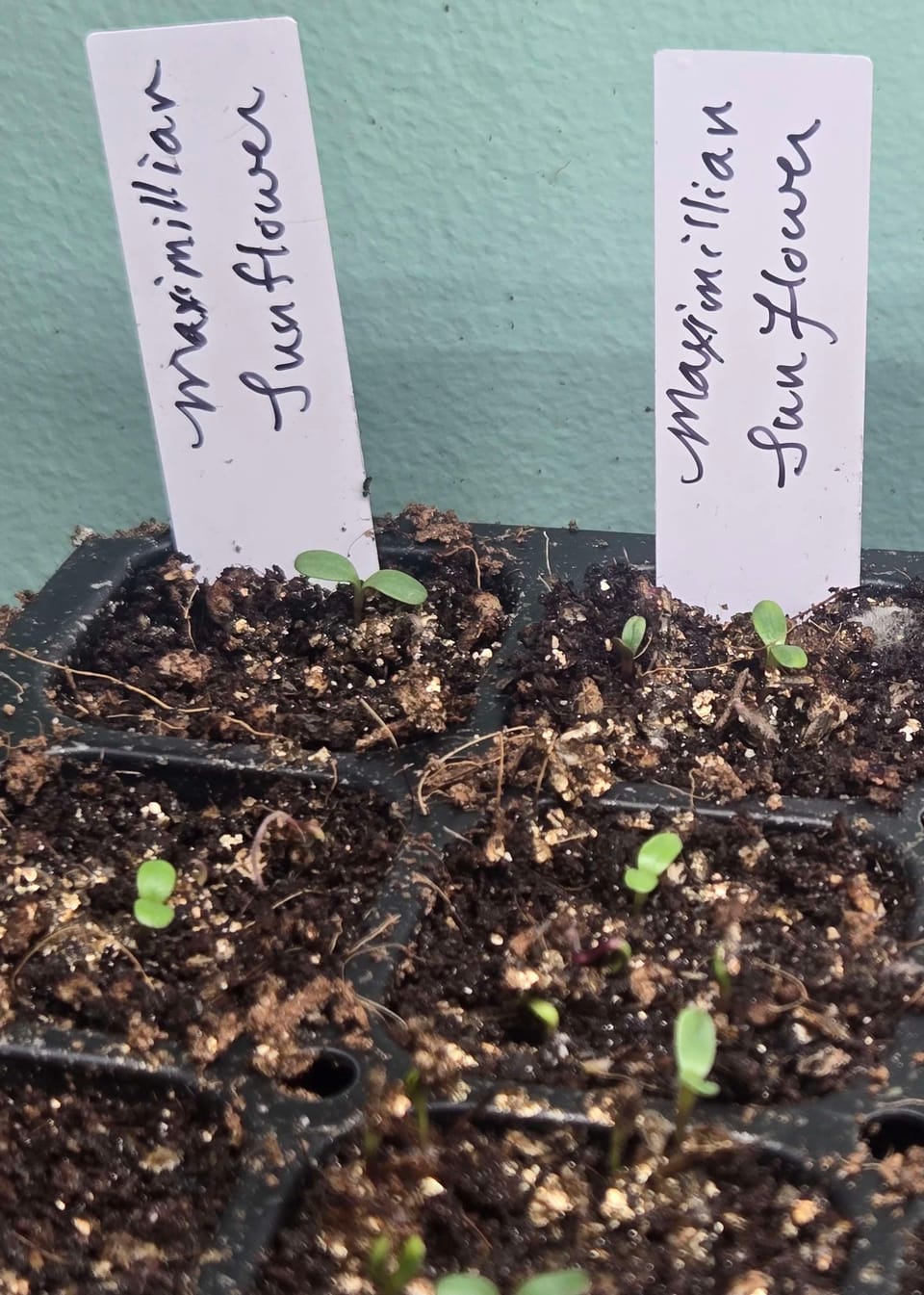
This time of year (roughly mid-February through early June) my life is largely ruled by the needs of seedlings.
If you are a gardener or subsistence farmer who grows a lot of things from seed, you likely know what I am talking about!
Between keeping track of which seeds need to be stratified and for how long,
to knowing which seeds need to be started how many weeks before the proverbial "last frost date,"
to monitoring the soil moisture, humidity, and lighting needs of the seedlings,
to being (somewhat) honest with myself about how many seedlings I should be starting to be able to reasonably expect to keep up with them through the season,
to maintaining vigilance about when it is time to pot up, harden off, and plant out a given plant...
Well, there's a lot to keep track of.
It's no wonder a lot of people choose to start their gardens with seedlings, rather than from seed! That is a totally valid option for folks for whom the process of seedlings is impossible and/or inaccessible within their lives, and it does not make you a lesser gardener!
(In fact, figuring out the approach to tending to plants that works for you is so much more important than trying to live up to the demands of any sort of gatekeeping, absolutism, or perfectionism!)
But for those who do want to start growing some of their plants from seed, or who have done some seed starting previously and would like to improve their success rates: welcome!
I wrote up some thoughts on setting yourself up for seed-starting success in my earlier post "Seed Starting: The Question of Timing," but I wanted to take a little time today to elaborate on a more subtle aspect of seed starting: enoughness.
The first year I started a significant number of plants from seed, I confess that I only had very modest success.
Oh, sure: some plants did fine.
But I also had a lot of seedlings who succumbed to damping off and/or who didn't have the resilience they needed to survive the hardening off and transplanting processes.
The season wasn't a complete bust, but there were enough disheartening losses along the way that I knew I could do better.
Over the years since, I have been very intentional with learning from mentors, friends, and the plants themselves. Through this time, I have come to one conclusion regarding what I my approach was lacking that first year:
A balanced sense of enoughness.
When initially starting seeds, I tended toward too-muchness. When filling the seedling trays with seed starting mix, I did what I have since learned was overpacking them with oversaturated soil. The result were conditions where the seed starting mix was too compacted for the tender roots of some species' seedlings.
And yes, the too-muchness often extended to over seeding the soil blocks (or, when time to direct sow came, the rows) and to starting more seedlings than I could reasonably expected to keep up with throughout the season.
(I may still do that last one a bit.)
Then, as the season progresses, the too-muchness that the plants had to navigate first can so easily be followed by not-enoughness. One thing I know to be true: over-whelming is often accompanied by under-noticing, under-watering, and under-tending.
One of my farming mentors once said that the best defense to all gardening problems is the farmer's footprints: in other words, the farmer's repeated and consistent presence and attention is key to responding to plants' needs as they arise.
After all, it is only through presence and attention that a gardener or farmer will recognize when their plants are showing signs of either too-muchness or not-enoughness.
I have certainly heard many folks who tend to plants (whether indoors and/or outdoors) chuckling about how plants oftentimes will show the same symptoms for "opposite" problems: for example, leaves that are wilted, yellowing, and/or browning can result from either over- or under-watering.
However, when looked at through the lens of enoughness, the problems are not "opposite" each other at all: rather, all are manifestations of a loss of homeostasis/internal balance.
The value of enoughness is evident within our own bodies, as well. After all, we too exhibit similarity of symptoms when our physical selves become unable to maintain homeostasis, regardless of the direction of deviation. For example, high and low blood sugar levels are often accompanied by some similar symptoms (e.g., changes in coordination, decreased concentration, headache), as are heat stroke and hypothermia (e.g., confusion, slurred speech, lack of coordination).
The direction in which a seedling (or our body) has strayed from homeostasis is, of course, determined contextually. The clues to over- or under- nourishment, watering, light, soil tilth and density, heat or cold exposure, etc. are ones that exist within the space surrounding the plant itself: in other words, even internal homeostasis exists relationally.
The metaphors connected to enoughness can, of course, be taken in so many applicable directions.
In the same way that both under- and over- nourishment inhibit a plant's ability to flourish, poverty acts with violent impunity upon humans' ability to flourish. Meanwhile, excess wealth creates and sustains the rapacious sadism of capitalist structures, thereby distorting those responsible, schisming them from their spirit and their conscious connection to all beings within the realm of sentience.
Similarly, both over-exertion and inertia each impact our ability to flourish.
As do over- and under-stimulation.
Isolation, or a life in which there is no access to solitude, silence, and/or stillness.
A life without adequate access to outlets for creative expression, or the demands of capitalism requiring a level of creative output that depletes, rather than fills.
We are not separate from nature.
(This is precisely why I, and many others, speak of humans and the more-than-human world, rather than humans and nature: to speak of the latter pair as if they were separate things is to deny that we, too, are nature.)
We are not separate from the very fine-tuned balances that must be maintained in order for life to be sustained and tended.
This, to me, is one of the many gifts of tending plants from seed (above and beyond the obvious gifts of food, medicine, beauty, and biodiversity that are offered by the fully grown plants): the process of caring for seedlings calls upon me to pay very close attention to these balance points, and to respond when I see indications of a plant who is straying too far from its needs in any direction.
When I practice looking at seedlings with such tender, responsive attention, I am practicing a skill that I can then direct toward how I pay attention to myself, my community, and the more-than-human world around me.
So much of humanity exists in ways that are so, so far removed from a balanced life of enoughness. This crisis is so far beyond individual responsibility in scope: the very nature of the white supremacist, capitalist overculture makes living a balanced life in which work, nourishment, creativity, contemplation, and community are all available in right measure for an individual's needs is nearly impossible.
Also: I do find it helpful to find and take steps that move my life and my actions into greater alignment with the idea of enoughness. (At the very least, I try to not say yes to things that I know at the onset will take me any further from enoughness than I am already.)
Perhaps the contemplation of the ways your bodymind has lost touch with enoughness may hold some gifts for you, too.
And what's more: I find it helpful to tap into the fact that I am angry, truly angry, and grieving, and despairing that the overculture has created a world in which everyone in my community is so far estranged from the conditions of enoughness that we have to fight so, so, so hard to preserve our hope in a future at all...
let alone a world, community, and society that is in right balance within itself and with the more-than-human world.
Perhaps you've been gaslit about the things that have been taken from us all as a result of the violence of the overculture, and also feel rage about how much courage it takes to not lose yourself and your hope.
But if there is one thing I know about the amazing queerdos in my life, if there is one thing we have in ample enoughness, it's courage... after all, etymologically and experientially, the root of courage is heart, and queerness is heart personified.
May all of your plants, and all of you, have all of the enoughness you need as you grow toward a better future.

Comments ()